
Phonics and reading
Termly Newsletters - Please find below our termly newsletters
At St Francis, we use Read Write Inc Phonics (RWI) to help your child develop their Literacy skills. Miss South is our Read Write Inc lead teacher, so if you have any questions about RWI, please contact the school and she will be happy to assist you.
How will my child be taught to read?
At St Francis Primary Academy we aim for all our children to become fluent, confident readers who are passionate about reading.
Children who read regularly or are read to regularly have the opportunity to open the doors to so many different worlds!
More importantly, reading will give your child the tools to become independent life-long learners.
We can achieve this together through:
- Read Write Inc, a program to help to your child read at school
- Encouraging children to develop a love of books by reading to them daily, at home and at school
- Giving children access to a wide range of books at school and at home
We start by teaching phonics to the children in the Reception class. This means that they learn how to 'read' the sounds in words and how those sounds can be written down.
This is essential for reading, but it also helps children learn to spell well. We teach the children simple ways of remembering these sounds and letters.
We use Read Write Inc Phonics (RWI) to give your child the best possible start with their Literacy development. Please take the time to read the information as it provides invaluable information as to how you can help and support your child in reading but it also helps children learn to spell.

Reading
The children:
- learn 44 sounds and the corresponding letters/letter groups using simple picture prompts – see below
- learn to read words using Fred talk and sound blending
- read from a range of storybooks and non-fictions books matched to their phonic knowledge
- work well with partners

Writing
The children:
- learn to write and form the letters/letter groups which represent the 44 sounds with the help of fun phrases
- learn to write words by using Fred Talk
- learn to build sentences by practising sentences out loud before they write
Talking
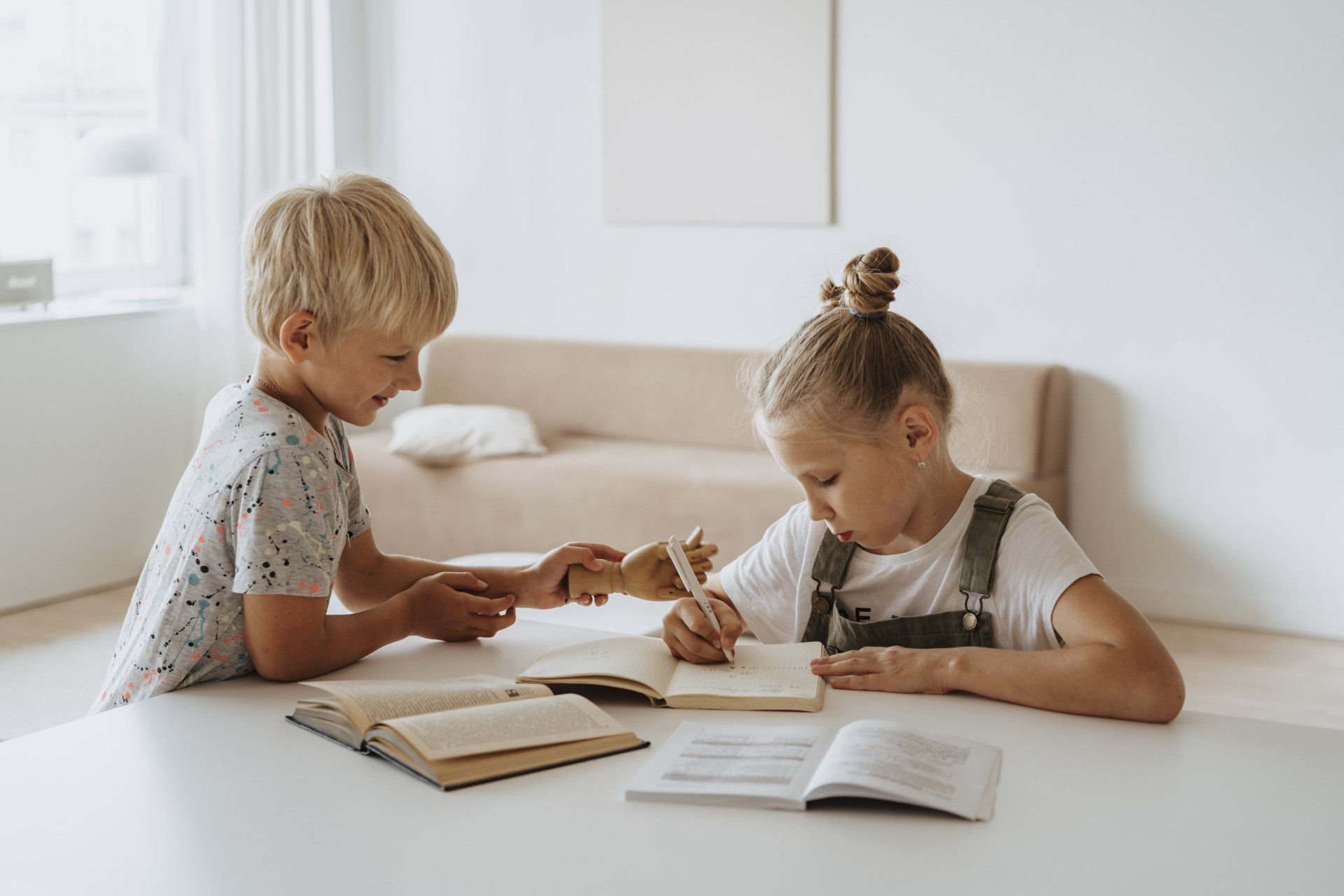
The children work in pairs so that they can:
- answer every question
- practise every activity with their partner
- take turns in talking and reading to each other
- develop ambitious vocabulary
Understanding Phonics
Parent video: Understanding Phonics
What is Read Write Inc Phonics?
Read Write Inc (RWI) is a systematic synthetic phonics programme which helps
all children learn to read fluently and at speed so they can focus on developing their skills in comprehension, vocabulary and spelling. The programme is designed for children aged 4-7. All children are assessed regularly by our RWI lead teacher. From these assessments children are organised into best fit groups, where they work with peers learning the same letter sounds and read the same books. This enables all children to meet their next steps on their reading journey.
Parent video: What is Read Write Inc Phonics
Fred Talk
Children will be taught how to read as follows:
Before you start to teach your child, practice saying the sounds below. These are the sounds we use to speak in English. Children initially begin using pictures for each sound, this will help children recognise the sound and then form the shape of the sound.
During Reception, children are introduced to Fred. Fred helps the children to learn to read. Fred can only speak in sounds so children are introduced to ‘Fred Talk’ and quickly learn to orally blend. Fred is an expert on sounding out words! E.g. m-o-p, c-a-t, m-a-n, sh-o-p, b-l-a-ck. Once children can confidently orally blend words and know their single letter Set 1 sounds, we know they are ready to read!
Parent video: Blending sounds with Fred
Read Write Inc Set 1, 2 and 3
The children are taught the sounds in 3 sets.
Step 1:
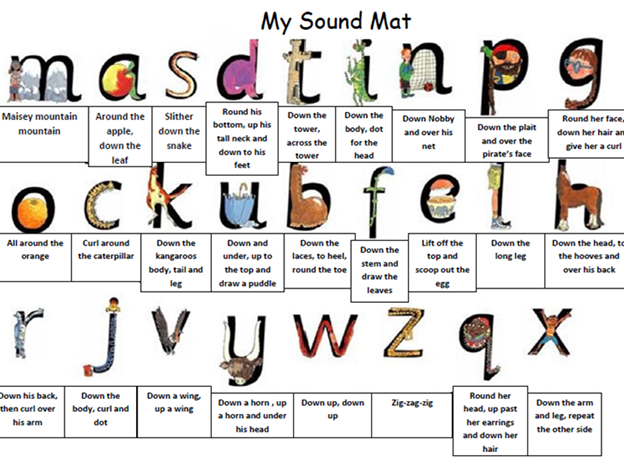
In Reception, Set 1 Sounds are taught in the following order together with rhymes to help children form the letters correctly and instantly recognise sounds ready for blending. We only focus on the letter sounds (not the letter names).
Set 1 Speed Sounds
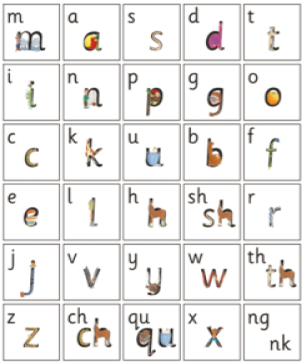
Set 1 handwriting rhymes
| Sound | Rhyme |
|---|---|
| m | Down Maisie then over the two mountains. Maisie, mountain, mountain. |
| a | Round the apple, down the leaf. |
| s | Slide around the snake. |
| d | Round the dinosaur's back, up his neck and down to his feet. |
| t | Down the tower, across the tower. |
| i | Down the insect's body, dot for the head. |
| n | Down Nobby and over the net. |
| p | Down the plait, up and over the pirate's face. |
| g | Round the girl's face, down her hair and give her a curl. |
| o | All around the orange. |
| c | Curl around the caterpillar. |
| k | Down the kangaroo's body, tail and leg. |
| u | Down and under the umbrella, up to the top and down to the puddle. |
| b | Down the laces, over the toe and touch the heel. |
| f | Down the stem and draw the leaves. |
| Sound | Rhyme |
|---|---|
| l | Down the long leg. |
| h | Down the horse's head to the hooves and over his back. |
| sh | Slither down the snake, then down the horse's head to the hooves and over his back. |
| r | Down the robot's back, then up and curl. |
| j | Down his body, curl and dot. |
| v | Down a wing, up a wing. |
| y | Down a horn, up a horn and under the yak's head. |
| w | Down, up, down, up the worm |
| th | Down the tower, across the tower, then down the horse's head to the hooves and over his back. |
| z | Zig-zag-zig, down the zip |
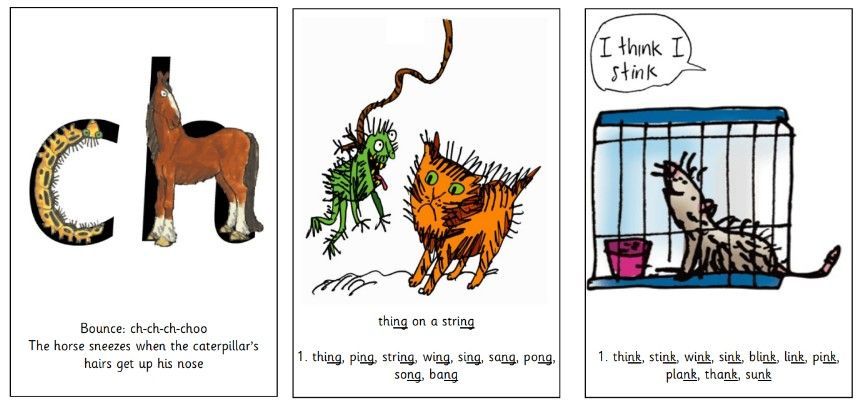
| ch | Curl around the caterpillar, then down the horse's head to the hooves and over his back. |
| qu | Down the queen's head, up to her crown, down her hair and curl. |
| x | Cross down the arm and leg and cross the other way. |
| ng | A thing on a string. |
| nk | I think I stink. |
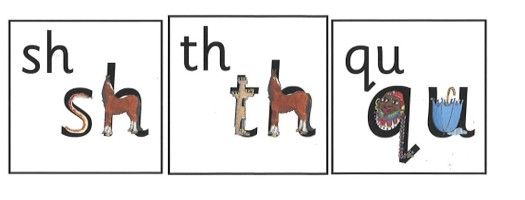
Set 1 ‘special friends’
In Reception, children learn the Set 1 ‘special friends’ (digraphs – two letters that make 1 sound).
Step 2:
The children are then taught Set 2 Sounds - the long vowels. When they are very confident with all of set 1 and 2 they are taught Set 3 Sounds.
Set 2 Speed Sounds
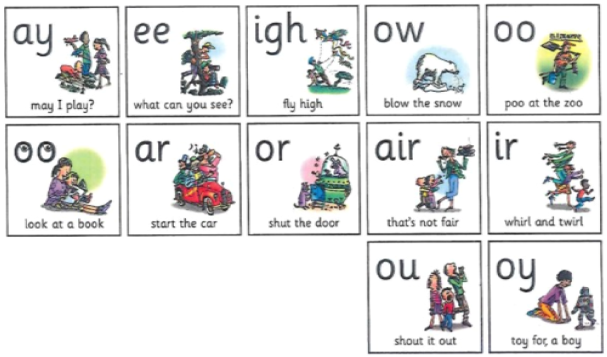
| Sound | Phrase | Words to practice reading and spelling |
|---|---|---|
| ay | ay: may I play | play, day, may, way, say, spray |
| ee | ee: what can you see | see, three, been, green, seen, sleep |
| igh | igh: fly high | high, night, light, fright, bright, might |
| ow | ow: blow the snow | blow, snow, low, show, know, slow |
| oo | oo: poo at the zoo | too, zoo, food, pool, moon, spoon |
| oo | oo: look at a book | took, look, book, shook, cook, foot |
| ar | ar: start the car | car, start, part, star, hard, sharp |
| or | or: shut the door | sort, short, horse, sport, fork, snort |
| air | air: that's not fair | fair, stair, hair, air, chair, lair |
| ir | ir: whirl and twirl | girl, bird, third, whirl, twirl, dirt |
| ou | ou: shout it out | out, shout, loud, mouth, round, found |
| oy | oy: toy for a boy | toy, boy, enjoy |
Set 3 Speed Sounds
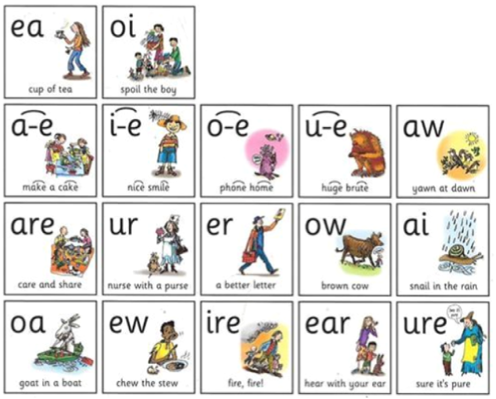
| Sound | Phrase | Words to practice reading and spelling |
|---|---|---|
| ea | Cup of tea | clean, dream, seat, scream, real |
| oi | Spoil the boy | join, voice, coin |
| a-e | Make a cake | make, cake, name, same, late, date |
| i-e | Nice smile | smile, white, nice, like, time, hide |
| o-e | Phone home | home, hope, spoke, note, broke, phone |
| u-e | Huge brute | tune, rude, huge, brute, use, June |
| aw | Yawn at dawn | saw, las, dawn, crawl, paw, yawn |
| are | Care and share | share, dare, scare, square, bare |
| ur | Nurse with a purse | burn, turn, spurt, nurse, purse, hurt |
| er | A better letter | never, better, weather, after, proper, corner |
| ow | Brown cow | how, down, brown, cow, town, now |
| ai | Snail in the rain | snail, paid, tail, train, paint, rain |
| oa | Goat in a boat | goat, boat, road, throat, toast, coat |
| ew | Chew the stew | chew, new, blew, flew, drew, grew |
| ire | Fire! Fire! | Fire, hire, wire, bon/fire, in/spire, con/spire |
| ear | Hear with your ear | hear, dear, fear, near, year, ear |
| ure | Sure it?s pure | pure, sure, cure, pic/ture, mix/ture, ad/ven/ture |
Parent video: How to say the Set 1, Set 2 and Set 3 sounds'
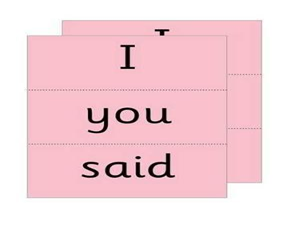
Red and Green words
During a lesson, children will be exposed to
red and
green words to learn to help them to become speedy readers.
Red words are words that are not easily decodable ("You can't Fred a red") and challenge words to extend children’s vocabulary.
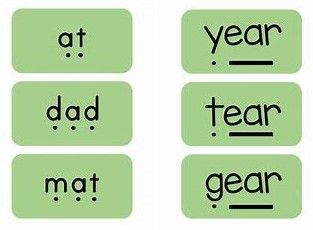
Green
words are linked to the sounds they have been learning and are easily decodable. Dots and dashes represent the sound each letter makes. The dash demonstrates a ‘special friend’ sound.
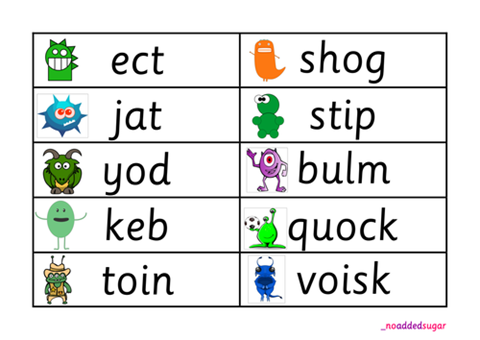
Nonsense words (Alien words)- What 'a load' or nonsense!
As well as learning to read and blend real words, children will have plenty of opportunities to apply their sound recognition skills on reading ‘Nonsense words’. These words will also feature heavily in the Year One Phonics Screening check in the summer term. These words provide endless opportunities for children to apply and practice their thinking in a range of different contexts.
What happens in class?
During the RWI session children will have a speed sound lesson followed by a storybook lesson. During the story book lesson, children will practice focus sounds, read the green and red words within the book, followed by the actual reading of the story within the book. Lessons in EYFS start from 10 mins and build up to 40 minutes by the end of Reception. KS1 lessons are also 40 minutes in length.
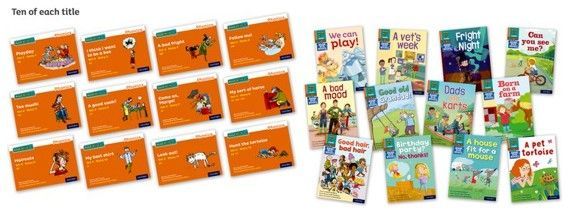
Children will read the book approximately three times in class (more for yellow, blue and grey books) and at each new reading they will have plenty of opportunities to practice using their developing comprehension skills. Once the book has been read three times, it will be sent home along with the ‘book bag book’. This is an additional book to complement the story your child will have read in class containing the same letter sounds.
How to help at home: Reading at home
Your child will start to bring phonics books home as soon as they know the Set 1 sounds and can Fred Talk (orally blend). This will be in addition to their reading for pleasure Library book.
Each term, children are assessed and when they are ready, will move to the next levelled phonics book to match their growing confidence when reading. Children only take home books that contain sounds and red words that they can read.
Once children are reading the red books onwards, they will take home 2 phonics books. One will be the book that they have read in their phonics lesson. The second will be a 'book bag' book which complements the phonics book they are reading.
It is important that children read their books at home everyday. This will support your child to become a confident and fluent reader.
Children should return their book folder to school every single day and ensure their books are safely stored within their St Francis Primary book bag.
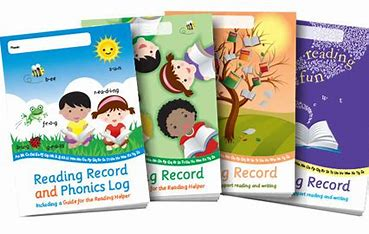
Please comment or sign in the parent book log when you listen to your child read.
Virtual phonics links on Class Dojo
Each day, your child's class teacher (Reception, Year 1 and Year 2) will post short virtual phonics lessons. These are normally around 2-3 minutes long. It is important that your child take the time to watch these on a daily basis. These are created for each reading group to support your child's next steps in their reading journey.
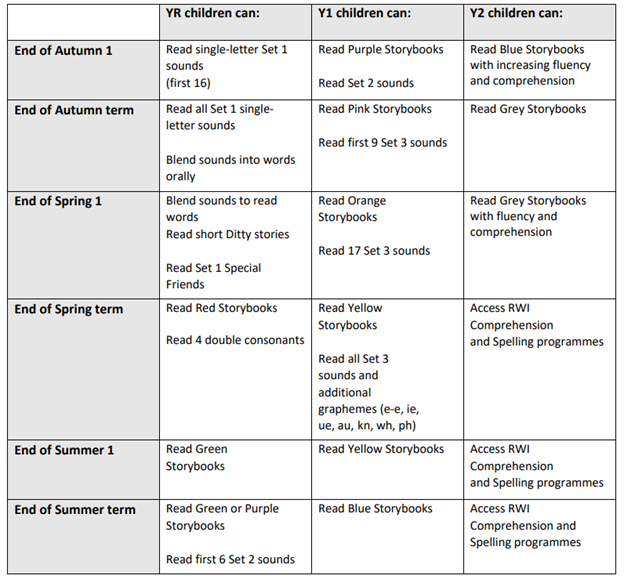
Progression through Read Write Inc
Children in Early Years are introduced to initial sounds. Children then begin to learn how to 'read' the sound in words and how those sounds be can be written down.
As children progress, they follow the same format as Early Years but will work on complex sounds and read books appropriate to their reading level.
Daily sessions of RWI phonics last 30 minutes. Once children become fluent speedy readers they will move on to the No Nonsense Spelling scheme.
Five key principles underpin the teaching in all Read Write Inc. sessions:
- Purpose – know the purpose of every activity and share it with the children, so they know the one thing they should be thinking about
- Participation – ensure every child participates throughout the lesson. Partnership work is fundamental to learning
- Praise – ensure children are praised for effort and learning, not ability
- Pace – teach at an effective pace and devote every moment to teaching and learning
- Passion – be passionate about teaching so children can be engaged emotionally.
We understand that children all learn at different levels. RWI set a general ‘expectation’ that most children will be at a given level at certain points throughout the year. With the homogenous groups, we are able to ensure children are in their ‘best fit’ group to enable them to read at their own level. Once children are working at the yellow level, the main focus is on building fluency and speed when reading.
Year 1 phonics screening assessment
Information of parents: Phonics screening check: information for parents
In the Summer term, Year 1 children will be assessed as part of national government assessment called the ‘Phonics Screening Check’. Year 2 pupils that did not meet the expected standard in Year 1 will also be retested. Children will be asked to read 40 words. Words will consist of a mixture of real, nonsense and multisyllabic words. Nonsense words (also referred to as ‘alien’ words) are words that are phonically decodable but are not actual words. They are included in the check specifically to assess whether your child can decode a word using their phonics skills. All nonsense words in the check are accompanied by a picture of an imaginary creature. Children are taught that when a word has a creature next to it, it is a nonsense word. The check is designed to give teachers information on how your child is progressing in phonics. It will help to identify whether your child needs additional support at this stage so that they do not fall behind in this vital early reading skill. Our Year 1 children are supported throughout the whole of Year 1 to enable them to be confident and successful readers. In the Spring term, all Year 1 children will receive a support pack and parents will be invited to attend a Phonics Screening meeting.
Parent presentation psc_parent_meeting.pptx
Key Phonics Terms
- Sound – The sound that a letter or group of letters make.
- Digraphs – Two letters which together represent one sound, e.g. sh, oi, ea
- Trigraph – Three letters which together represent one sound, e.g. igh, ear
- Split Diagraph – Two letters, which work as a pair to represent one sound, but are separated within the word, e.g. a-e in cake; o-e in note
- Blending – The process of using phonics for reading. Children identify and blend the individual sounds together to hear and say the whole word.
- Segmenting – The process of using phonics for spelling and writing. Children listen to the whole word and break it down into the letter-sounds. E.g. ‘lunch’ can be segmented as l-u-n-ch.
- Red word (also known as ‘tricky word’) – These words have an unusual or tricky spelling, e.g. said, one, their. They are not spelt as they sound and so children are not able to write these words with phonics alone.
For more information about phonics please see the presentation below:
Reading at home Booklet 1 (attach) Phonics booklet 1.docx
Reading at home Booklet 2 (attach) Phonics booklet 2.docx
If you have any questions regarding phonics in Reception or KS1, please do not hesitate to contact Miss South (phonics lead).
Useful websites for Parents
Please find a list of websites that you may find useful in helping you and your child learn about phonics. Games and fun activity websites are also included.
https://www.ruthmiskin.com/en/find-out-more/parents/ - Information and resources to support phonics learning at home
https://www.ictgames.com/literacy.html - fun games for the children to play
BBC Bitesize - many games to play covering all areas of the curriculum
Read Write Inc guide for parents
The following link provides lots of free Read Write Inc. Phonics resources to help your child, including eBooks, practice sheets and parent films.
https://home.oxfordowl.co.uk/reading/reading-schemes-oxford-levels/read-write-inc-phonics-guide/





 by
by